
ARTICLE
Acting Beyond the Surface: A 70-Year Legacy of Asking, “Is There a Better Way?”
Sustainability isn’t a fixed destination; it changes with the questions we ask. What begins as a conversation about reducing waste can lead to completely rethinking the manufacturing process. A focus on recycled content prompts a deeper look at where materials come from and where they go next. Ultimately, the push for transparency turns environmental data into a vital resource for better design decisions.
For Wilsonart, sustainability efforts haven't been a sudden shift, but rather an ongoing journey of continuous improvement.
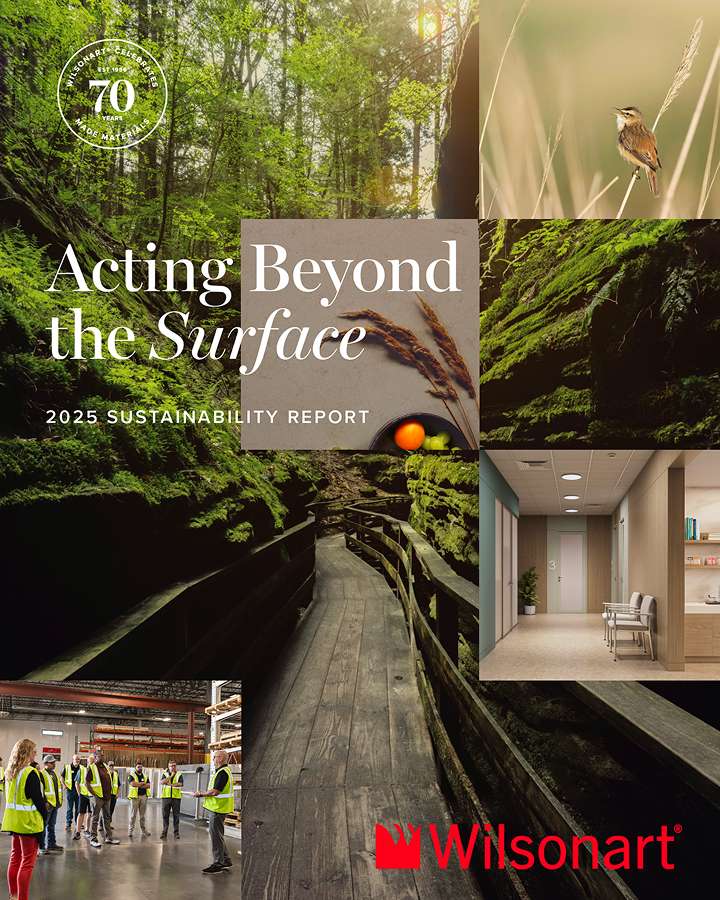
As we proudly celebrate Wilsonart’s 70th anniversary, our 2025 Sustainability Report, Acting Beyond the Surface, explores exactly how this history of material innovation continues to shape our path forward. We sat down with Kate Grossman, Vice President of Marketing and Design, and Adam Biedrzycki, Director of Sustainability, to pull back the curtain on how we are driving progress from the factory floor to the designer’s library.
 |
KATE GROSSMAN
|
 |
ADAM BIEDRZYCKI
|
Q: Sustainability means different things to different people. How has the conversation evolved at Wilsonart over the years?
Kate Grossman: From a design and marketing perspective, it’s no longer just about offering a "green option." Sustainability is now fundamentally changing how designers evaluate materials. It influences everything we create. The push for transparency has actually turned environmental data into a creative resource for better design decisions.
Adam Biedrzycki: Exactly. For us on the operations side, that evolution has been underway for decades. Our 2025 Sustainability Report, Acting Beyond the Surface, explores how our history of material innovation continues to shape our path forward. We are looking at everything from increasing recycled content and recovering manufacturing byproducts to expanding product transparency and measuring our true carbon and resource use.
Q: You mention a history of innovation. Where did this sustainable mindset actually begin for Wilsonart?
Kate: You can trace the roots of this mindset all the way back to 1961. Our founder, Ralph Wilson Sr., introduced a 5-by-12-foot laminate press that allowed two standard kitchen countertops to be produced from a single sheet. Now, to be fair, Ralph Sr. probably wasn’t trying to be a green pioneer back then—he was focused on smart engineering and reducing material waste to make manufacturing more efficient.
Adam: Right, but when we look at his breakthrough through a modern lens, it represents the exact core of what we do today. He proved that resource efficiency and great design go hand-in-hand. More than six decades later, that foundational principle still holds true for my team: true innovation means getting the absolute most value out of every raw material.
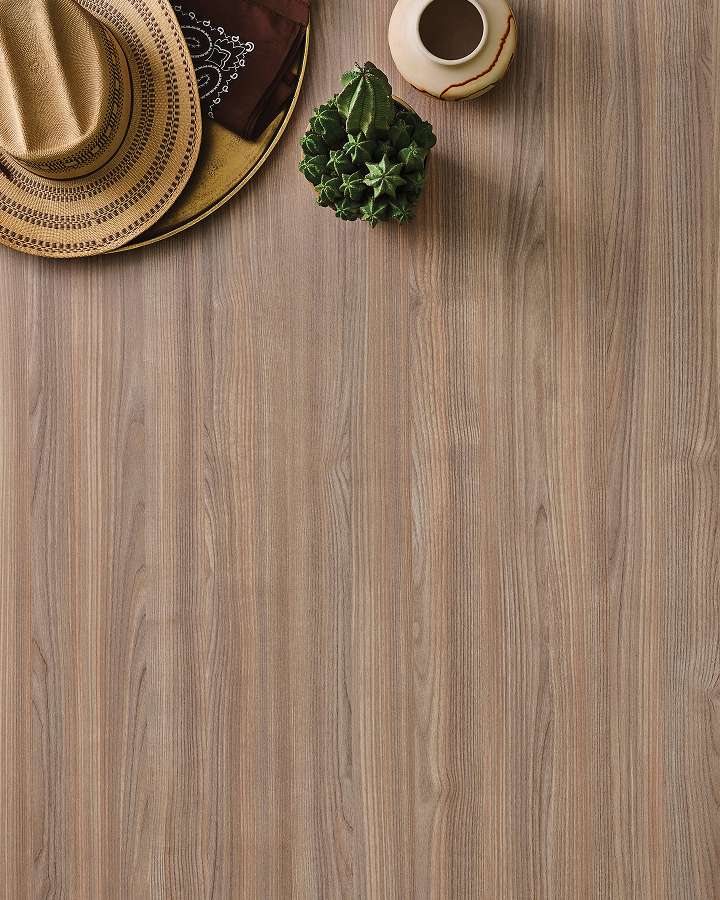
Design Featured: HPL: Harmonia
Q: Looking at manufacturing today, how are we putting that philosophy into practice when it comes to waste?
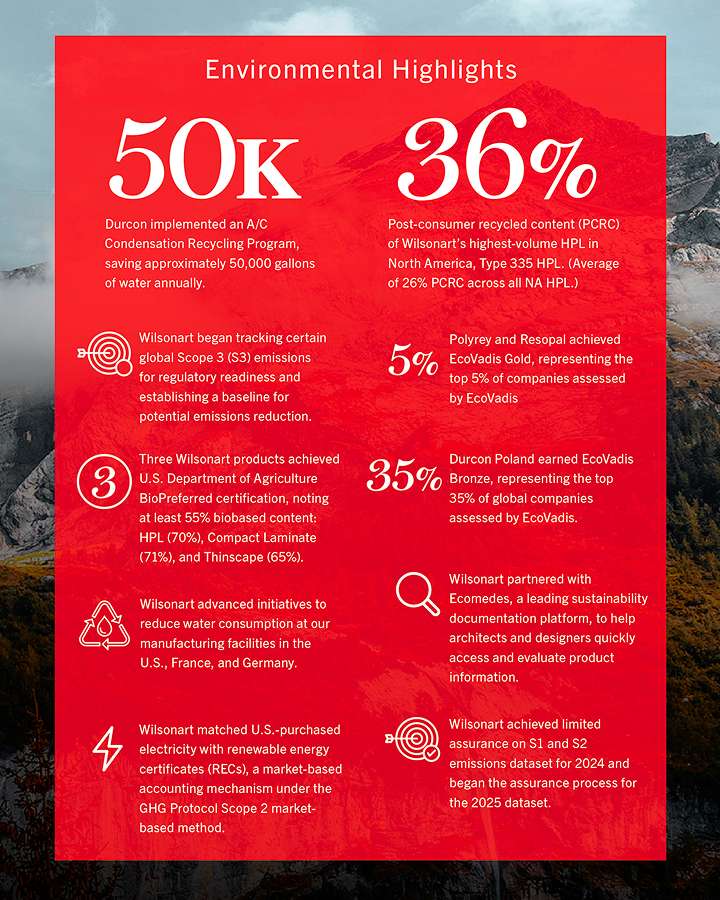
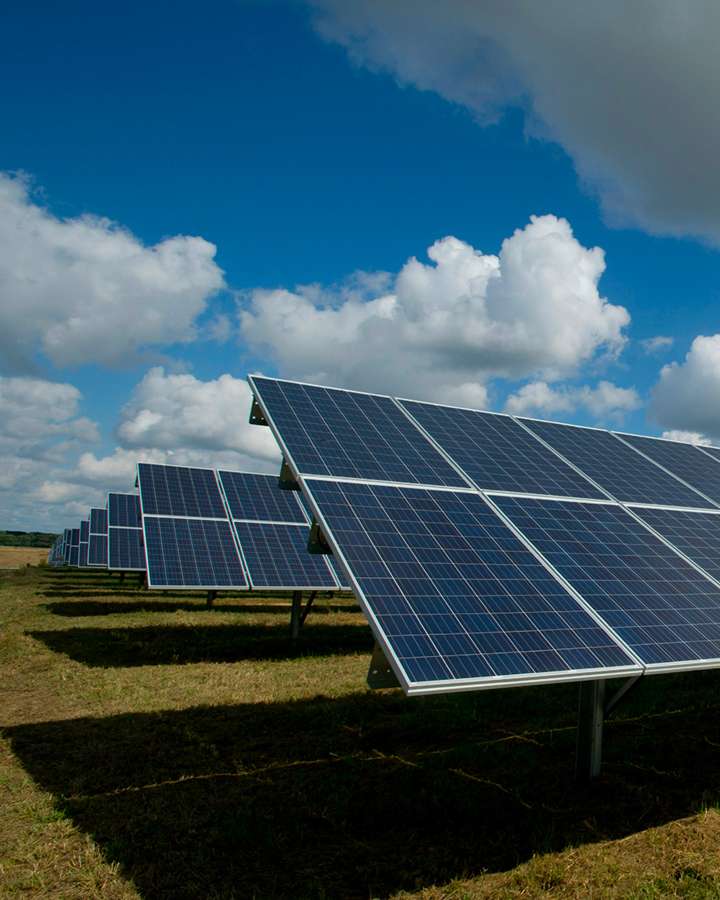
Adam: The question for us is no longer simply how to create less waste, but what value might still exist within it. For example, we've set an ambitious goal of reaching 40% post-consumer recycled content in our HPL by the end of 2027. We are making steady progress—our average recycled content increased from 23% in 2023 to 26% in 2025, while our best-selling Type 335 HPL reached 36% post-consumer recycled content in 2026.
We are also finding incredible ways to reuse materials directly inside our facilities:
• In Fletcher, North Carolina: We convert sander dust into process heat, which has cut the manufacturing waste we send to landfills by more than one-third.
• Right here in Temple, Texas: We capture methyl methacrylate and convert it back into reusable material, recovering approximately 740 gallons annually.
Q: Designers and specifiers are looking for real, verifiable data. How is Wilsonart addressing the demand for product transparency?
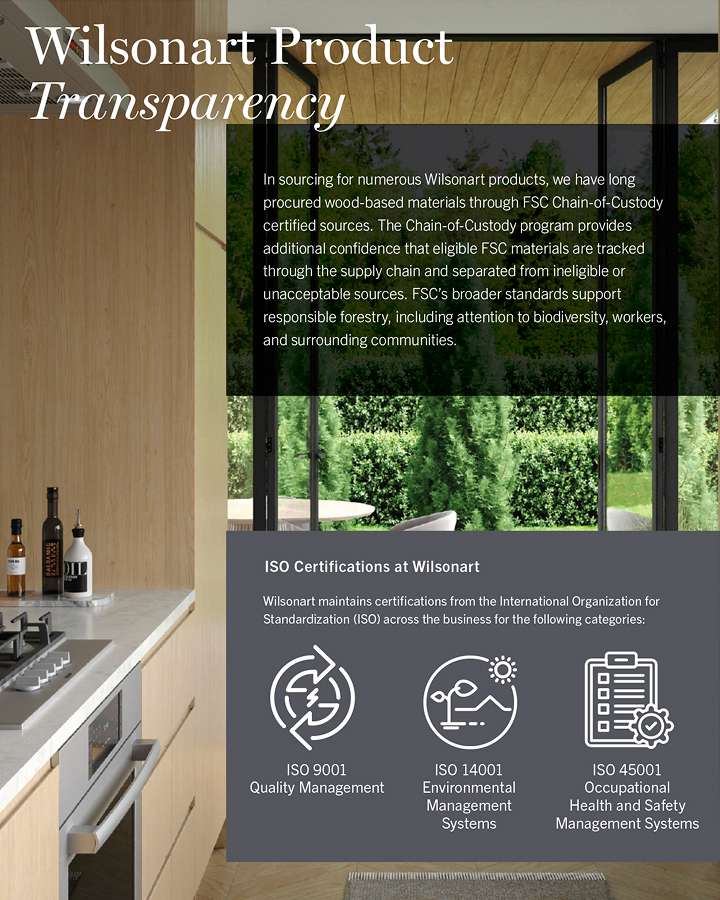
Kate: This is where design and sustainability truly intersect. Designers want to build beautiful spaces, but they need to know the environmental footprint of what they are specifying. We are continually expanding our Environmental Product Declarations (EPDs), alongside Declare labels, Health Product Declarations (HPDs), and rigorous indoor air quality certifications.
To ensure this data is actually useful and accessible, we partnered with Ecomedes in 2025 so designers and specifiers can find, track, and utilize this information instantly for their projects.
Q: Some of the biggest impacts come from changing an entire system rather than just tweaking a product. Can you share an example of that?
Adam: Absolutely. Some of our most meaningful improvements come from completely reconsidering how a system works in the first place. At our Polyrey facility in France, we redesigned our entire cooling system. This change reduced the water we draw from the La Sarsonne River by approximately 98% while completely eliminating the return of warm water to the natural source.
Kate: It’s a reminder to our whole team that sustainability does not always mean adding something brand new. Sometimes, it just means looking at an existing process through a completely different lens.
Q: After 70 years of business, what is the main takeaway from this year's report?
Kate: After seven decades, the tools, technologies, and environmental challenges have certainly changed, but our fundamental question remains exactly the same: Can we find a better way to do this?
Adam: For everyone here at Wilsonart, that single question is what continues to shape what comes next.
EXPLORE OUR PROGRESS
Want to dive deeper into our data, goals, and initiatives? Read the full 2025 Wilsonart Sustainability Report to see how we are building a more sustainable future from the inside out.
Design Featured: Quartz: San Angelo
To read more articles, visit our Inspiration page.
WILSONART EMAIL NEWSLETTER
Stay Connected.
Sign up to get interesting news and updates about new products, tools, and inspiration delivered right to your inbox.

Validate your login
Sign In
Register